Welcome to the official chronicle of the Vibecraft project. What you are looking at should not exist. At least according to the laws of traditional software engineering. Vibecraft is a real-time strategy game with lockstep deterministic peer to peer networking supporting up to 8 players in a 4 vs 4 format. I would say that AI helped me build it, but that wouldn't be accurate.
The truth is that I helped AI build it.
A project that would tradionally take potentially dozens of team members months to build, instead took one person a few weeks.
This isn't a prototype, it's a fully fleshed out game - actually more of a game engine - with a full featured map editor, unit editor, building editor, resources editor, abilities editor, tech tree editor, creep camp editor, and an items/gear & loot tables editor.
The Super-Powered Developer
The narrative of "AI as a coding assistant" is too small. It misses the point. AI didn't just "help" me write functions; it acted as my Art Department, my Network Engineer, and my Gameplay Designer. Vibecraft is proof that a single person, armed with AI tools, can now wield the output capacity of a small studio.
I didn't type every line of the PathfindingSystem. I didn't hand-sculpt the vertices of the Time Sword.
I operated as a Director. I held the vision, and the AI agents executed the labor. The result is a codebase that feels less like it was written and more like it was grown.
Shattering the "Asset Wall"
For solo developers, the dream usually dies at the "Asset Wall." You can write code, but you can't model 50 unique characters, animate them, and texture them. But in the era of Vibe Development, the Asset Wall is an illusion.
Look at the roster we created in just four weeks. This isn't a tech demo with one "hero" and one "enemy." This is a living world:
The Human Alliance
We didn't just make a "soldier." We made Peasants, Footmen, Archers, Paladins, Priests, Wizards, Monks, and Siege Catapults. Each with unique stats, voice lines, and gear like the Flame Bow or Viking Helmet.
The Skelly Horde
A completely distinct faction with organic bone architecture. Skelegrunts, Firesages, Bone Archers—all fully animated, all distinct.
The Living World
The map is populated by Blue Ogres, Bandits, Stone Golems, Poison Spiders, and Goblins. We even have naval units like Submarines and Battleships.
The Loot
Dozens of equippable items. Time Daggers, Electric Shields, Frost Swords. These weren't painstakingly modeled; they were hallucinated into 3D existence.
I generated the concepts with image models ("nano banana pro images"), turned them into 3D meshes with Hunyuan 3D, and auto-rigged them. What used to take a month of artist time took an afternoon of "Vibing."
Architectural Omniscience
Usually, when a solo dev tries to build a multiplayer engine, they drown in complexity. "How do I sync state?" "How do I optimize 500 units?" AI solved the "How." I focused on the "What."
1. The "Impossible" Networking
I told the AI: "I want a Deterministic Lockstep simulation like the RTS games of old."
It didn't blink. It architected the DeterministicLoop, the StateHasher to catch desyncs, and the P2P signaling via Google STUN servers.
It knew the patterns that would have taken me weeks of research to rediscover.
2. Performance Magic (VAT)
I said: "The browser is lagging with 200 skeletons."
The AI suggested and implemented Vertex Animation Textures (VAT). We built a custom VATBaker.js that bakes animation frames into textures, allowing the GPU to handle thousands of units effortlessly.
This is AAA-level tech, implemented by a "solo" dev in a day.
3. The ECS Backbone
We built a pure Entity Component System. CombatSystem, MovementSystem, ConstructionSystem—all decoupled, all performant.
The AI ensured the architecture remained clean, preventing the "spaghetti code" that usually kills rapid prototypes.
The Death of the Code Editor
Here's a confession that would make any traditional developer twitch: I started this project the "normal" way. VS Code open on my desktop, SSH'd into my dev box, terminal running AI coding assistants. The classic modern setup. But something strange happened over the first few days.
I noticed I was using VS Code exclusively as a file browser. The code editor pane? I had literally shrunk it to nothing. It wasn't a conscious decision—I just never needed it. I wasn't reading code. I wasn't scanning for bugs with my eyes. I wasn't manually tracing function calls. The AI was doing all of that.
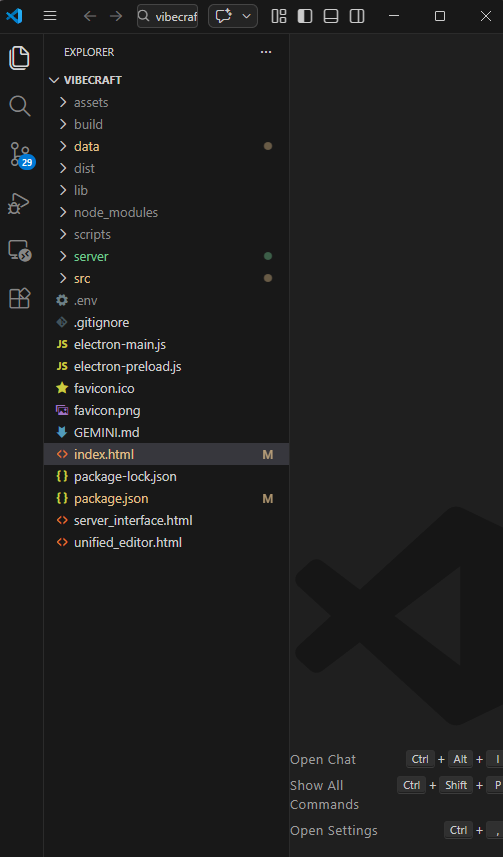
My actual VS Code workspace. Notice anything missing? There's no code visible. At all.
Look at that screenshot. That's my real workspace. The file explorer is the entire window. The VS Code logo watermark sits where an editor pane should be—but isn't, because I had collapsed it completely. I was asking the AI to do things as trivial as changing a single value on a single line to tune a gameplay parameter. Not because I couldn't do it myself, but because describing what I wanted was faster than finding the file, scrolling to the line, and editing it manually.
This is the moment I understood what Vibe Development actually is. It's not "coding with AI help." It's directing a project at the level of pure intent. The code becomes an implementation detail—something that exists beneath the surface, like machine code exists beneath Python. You stop thinking in syntax and start thinking in systems.
Building the "Factory"
Perhaps the ultimate flex of this month-long sprint was that we didn't just build the game. We built the tools to make the game. If I wanted to tweak a spell, I didn't edit a JSON file. I opened the Ability Editor—a tool the AI built for me.
- Map Editor: Paint terrain and place resources.
- Unit Editor: Tweak the Paladin's crit chance or the Ogre's aggro range in real-time.
- Building Editor: Define the footprint of a Sanctum or Boneyard.
The Vibe Conclusion
Vibecraft is more than a game. It is a beacon. It demonstrates that the constraints of the past—time, budget, manpower—are dissolving. If one person can build a networked, optimized, asset-rich RTS engine in 30 days, imagine what you can do.
Don't just code. Vibe.
← Back to Home